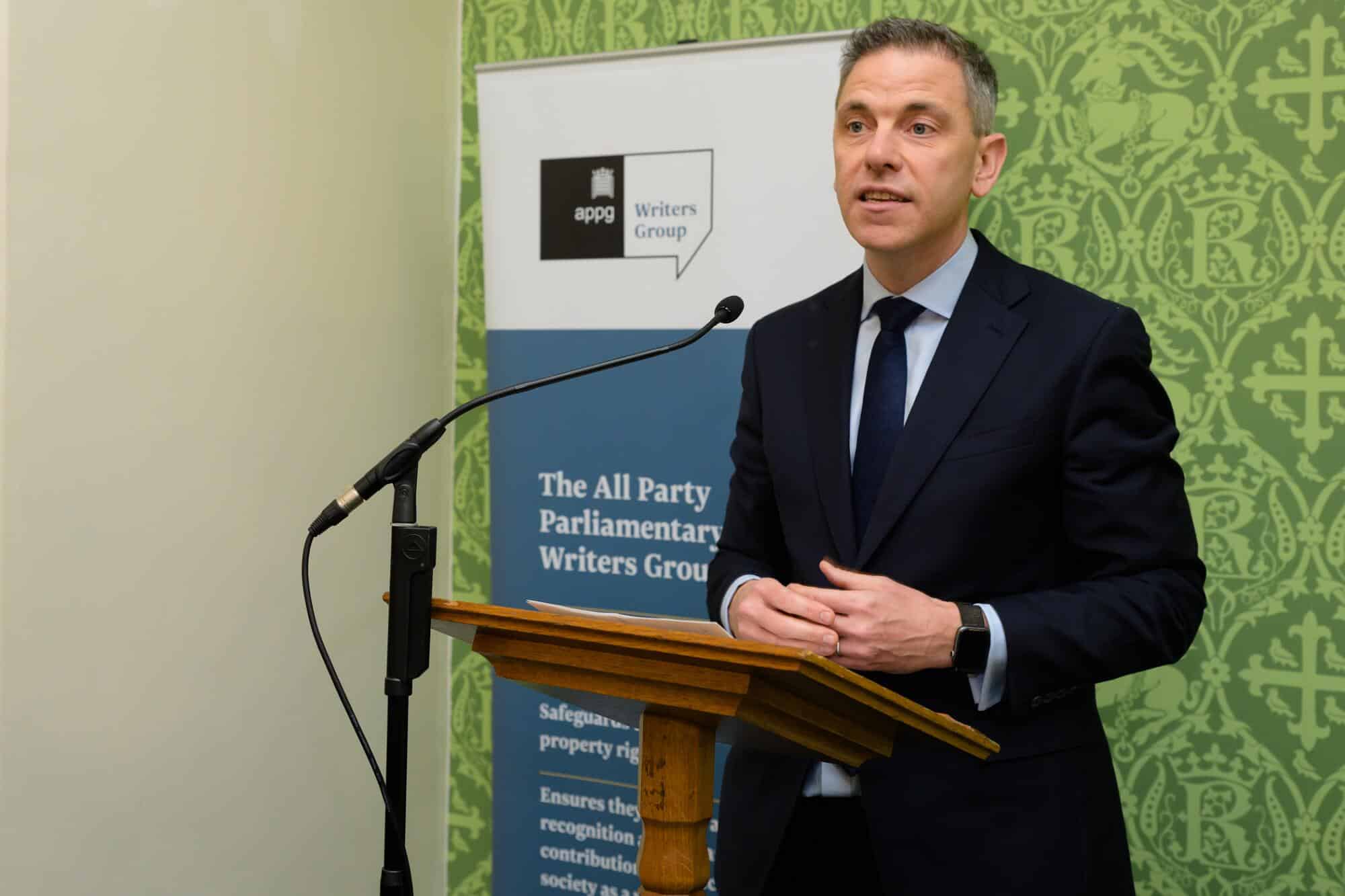
The All Party Writers Group Hosted its 2025 Winter Reception on 2 December. The event brought together parliamentary group members, writers and representatives from across the creative industries. Speeches and presentations in the event covered a range of issues of concern to writers, with a a strong focus on artificial intelligence, its impact on writers and the potential for writers to seek compensation for the use of their work.
The APWG Chair, Chris Evans MP opened proceedings with a review of the year and looking ahead to 2026, which has been announced as the National Year of Reading, he gave reflections on the importance of literacy:
“Reading changed my life and is the reason I’m standing here today. It opened up a new world to me beyond the realms I grew up in. The National Year of Reading will increase awareness of this important issue and help to address the steep decline in reading in all age groups, especially children. It aims to engage everyone to improve the reading culture in the UK, with a focus on giving children better chances in life through literacy skills.”
Lord Clement-Jones discussed developments around AI and copyright from the perspective of parliament and his position as ALCS Chair. He discussed the need to allow licensing to address the unauthorised use of writers’ works to train AI systems, as well as ALCS’s exploration of a licence for AI training:
“Copyright-created content is not an input to be taken for granted, but an asset that needs clear, enforceable rights. Creators want a regime based on transparency, licencing, choice and transparency. We are arguing for licensing models that that give technology companies access to the content they require, while preserving genuine choice and control for creators.
ALCS is working with the Copyright Licensing Agency in developing a specific licence for training generative AI systems, initially focused on professional academic and business content, where licencing is already well embedded and where small language models can be tested and trained in a controlled way.”

Dr. Clementine Collett, from the Minderoo Centre for Technology and Democracy, spoke about her recent research into the impacts of AI on novelists:
“The recommendations from our research really focus on amplifying the voices of these literary creatives. And the report recommends fostering a licencing market, which is underpinned by transparency from AI companies and training data that is based on informed consent and fair remunerations for creatives for the use of their work.”
Dr. Clementine Collett’s report can be found here.
Tim Dawson, Freelance Organiser at the National Union of Journalists (NUJ), spoke about the SCOOP initiative and the survey of its freelance members on their views on a potential collective licensing scheme:
“The SCOOP initiative between ALCS, the NUJ and others to creative a collective collection model that would fairly reward freelance journalists for secondary uses of their work. The NUJ surveyed its freelance members to gather their opinions about AI and the potential appeal of a model such as this. More than 400 NUJ members responded and three fifths of them thought that their work should only be used for AI learning with their explicit consent. A similar proportion thought where their material had already been used for AI learning, compensation through collective licencing would be appropriate.”